Compare

YAKKL vs Claude Code, Codex, Antigravity, and Grok Build

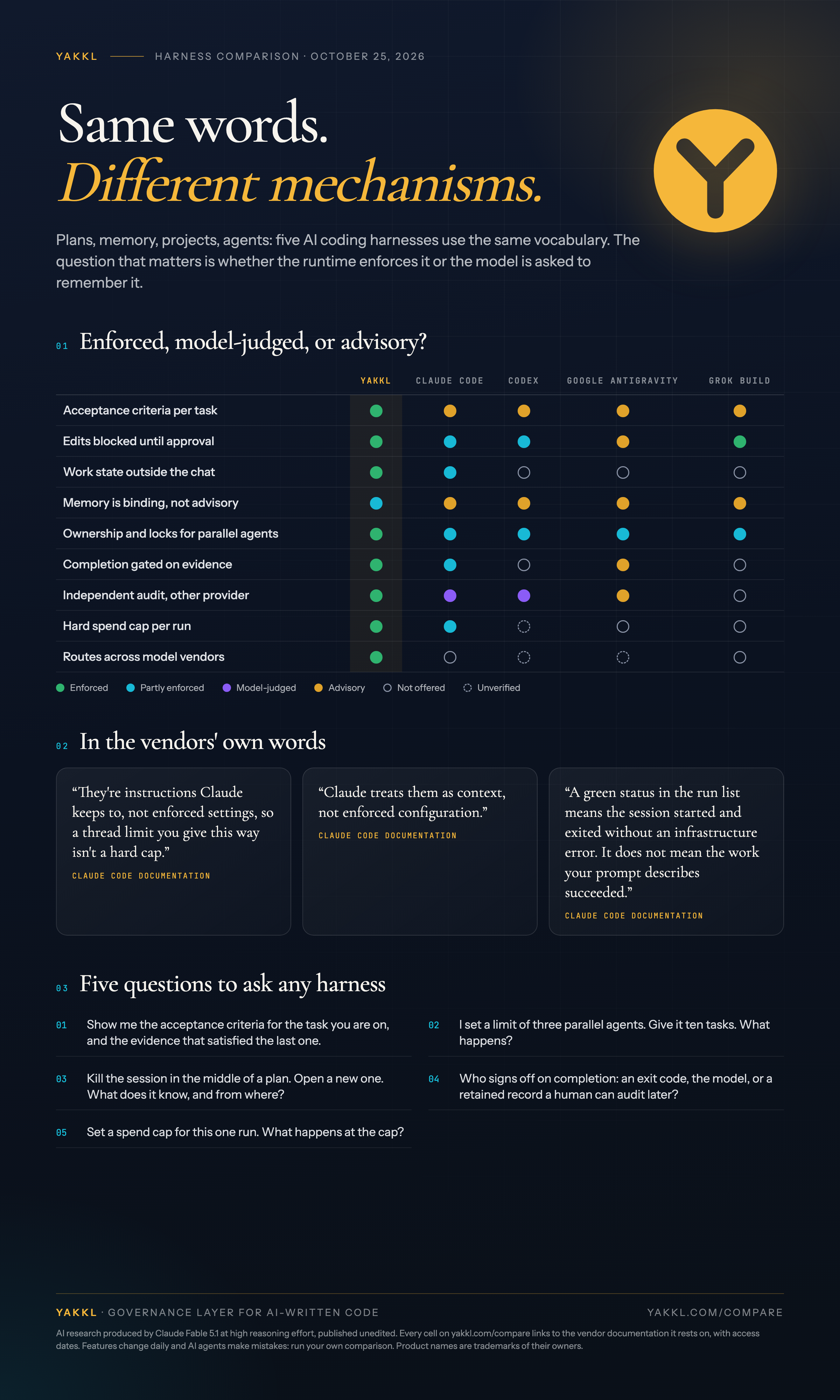
Every harness now says plans, memory, projects, and agents. This page asks a narrower question of each one, row by row: does the runtime enforce it, or is the model asked to remember it? Each cell cites the vendor's own documentation so you can check the claim instead of trusting it.

Research window 2026-10-24 to 2026-10-25. Last checked October 25, 2026. Published unedited.

In their own words

Same words, different mechanisms

The clearest evidence is what each vendor's documentation says about its own feature.

“They're instructions Claude keeps to, not enforced settings, so a thread limit you give this way isn't a hard cap.”

Claude Code Let Claude coordinate ongoing work with Projects6

“Claude treats them as context, not enforced configuration.”

Claude Code How Claude remembers your project8

“A green status in the run list means the session started and exited without an infrastructure error. It does not mean the work your prompt describes succeeded.”

Claude Code Automate work with scheduled tasks (formerly routines)9

“Keep required team guidance in AGENTS.md or checked-in documentation.”

Codex Memories18

“There won't be 1:1 feature parity right out of the gate.”

Google Antigravity An important update: Transitioning Gemini CLI to Antigravity CLI24

“Editing a status string or moving a directory does not prove completion.”

YAKKL YAKKL: How it works (orchestration, plans, audits)2
The matrix

Enforced, model-judged, or advisory

Sixteen rows, five harnesses. Every cell carries the mechanism, not a checkmark, and a footnote to the source. For when you want to verify rather than be told.

  • Enforced. A deterministic check the runtime applies. The model cannot talk its way past it.
  • Partly enforced. Some surfaces or settings enforce it; others only advise or leave it to the model.
  • Model-judged. A classifier or reviewer model decides. Useful, but a judgment, not a gate.
  • Advisory. Instructions or preferences the model is expected to follow. Nothing stops it if it does not.
  • Not offered. Not offered, or not documented by the vendor.
  • Unverified. Could not be confirmed from vendor documentation during the research window.
QuestionYAKKLClaude CodeCodexGoogle AntigravityGrok Build
Plans
Plan carries acceptance criteria and verification per task Enforced

A plan defines scope, ordered tasks, acceptance criteria, and verification. A task closes on accepted evidence, not an edited status line. 2

Advisory

Plan mode writes a markdown plan under ~/.claude/plans. Approving it exits plan mode. No criteria, dependency, or completion tracking is documented. Ultraplan was removed. 714

Advisory

/plan toggles plan mode and /goal sets a persistent goal. No acceptance ledger is documented. 20

Advisory

/plan drafts an Implementation Plan artifact with verification checkpoints; you click Proceed. Storage and completion tracking are not documented. 27

Advisory

Plan mode lets you approve, comment on steps, or rewrite the plan. No acceptance criteria tracking is documented. 30

Edits blocked until the plan is approved Enforced

A plan enters processing only through its start operation, and a task runs only from a published execution packet. 2

Partly enforced

Plan mode blocks edits until approval, except in interactive terminals where bypass permissions are available; there, planning is not enforced. 7

Partly enforced

Plan mode itself is prompt-level per third-party guides. The read-only sandbox is the enforced option. 1922

Advisory

Review happens before code changes; whether the agent pauses is governed by artifact review policies, not documented as a hard gate. 27

Enforced

Vendor states every edit is blocked until you approve the plan. 30

Work state lives outside the chat (states, transitions, dependencies) Enforced

IDEA, architecture documents, and plans carry lifecycle state in a project database with native transitions. A fresh session reads the record, not the transcript. 2

Partly enforced

Projects track thread states (ready for review, waiting on you, landing, resolved). Agent teams keep a shared task list with dependencies, and the docs note status can lag. No plan lifecycle. 610

Not offered

Chats persist with transcripts and /goal persists a goal. No lifecycle record is documented. 1620

Not offered

Conversations persist and reattach to their project; task groups and artifacts exist per conversation. No lifecycle record is documented. 28

Not offered

Sessions are saved and resumable. No lifecycle record is documented. 32

Memory and instructions
Are instructions and memory binding or advisory? Partly enforced

Prose guidance is advisory, as it is everywhere. The facts that matter (state, eligibility, ownership, evidence, spend) are checked by the yakkl binary, so the model forgetting them changes nothing. 1

Advisory

Docs: Claude treats CLAUDE.md and auto memory as context, not enforced configuration. Project preferences are instructions Claude keeps to, not enforced settings. 86

Advisory

Memories are generated state, off by default. The docs say to keep required team guidance in AGENTS.md or checked-in documentation. 18

Advisory

Rules, skills, and hooks are documented; project memory is not. 2826

Advisory

AGENTS.md is read; memory is reported as an on/off switch. 3032

Durable memory shared across people and harnesses Enforced

Project records and memory live in the project, not in one person's home directory, and are harness-neutral. Team and Business plans share them. 3

Partly enforced

Auto memory is per machine and repository; the MEMORY.md index loads only its first 200 lines or 25 KB. A Project's memory belongs to one user and cannot be shared. 86

Not offered

Local store under ~/.codex/memories, per user, off by default. 18

Unverified

Not documented during the research window. 28

Not offered

Local sessions; no shared memory documented. 32

Coordination
Parallel agents with declared write sets, ownership, and locks Enforced

Tasks declare their files. Ownership and locks are checked before a write; foreign changes are preserved and attributed, never claimed. 1

Partly enforced

Agent teams use file locking for task claims only; docs advise splitting files so teammates do not overwrite each other. Project threads isolate by branch. Teams are experimental and off by default. 106

Partly enforced

Subagents and git worktrees isolate work. No ownership or lock model is documented. 21

Partly enforced

New-worktree mode gives each conversation its own worktree to prevent conflicts. No lock model is documented. 28

Partly enforced

Up to eight subagents in isolated worktrees. No lock model is documented. 3031

Concurrency and thread limits are enforced caps Enforced

Agent depth, concurrency, spending, and cancellation are controlled by the configured runtime and permissions, not by asking nicely. 4

Partly enforced

Workflows cap concurrent agents (16 by default) and 1,000 agents per run at runtime. A Project thread limit you ask for is a preference rather than a cap. 116

Unverified

Not documented during the research window.

Unverified

Third-party reviews cite a parallel-agent limit; not confirmed in vendor docs. 29

Enforced

Eight concurrent subagents maximum. 31

Verification
Completion requires evidence for every acceptance criterion Enforced

A plan completes after the required evidence is accepted. An exit code or reviewer receipt proves a bounded fact, never production behavior on its own. 2

Partly enforced

Nothing by default: a green scheduled run does not mean the work your prompt describes succeeded. A TaskCompleted hook can block completion if you write one. 910

Not offered

Not documented.

Advisory

Agents follow the approved plan, validating each milestone with tests. No evidence ledger is documented. 27

Not offered

Not documented.

Independent audit by a different provider that can block continuation Enforced

Scheduled audits run in a fresh session with a provider different from the implementers. A failed mandatory audit blocks the continuation that needs it. 2

Model-judged

/code-review and ultrareview (research preview) run Claude reviewers against a branch or PR. Same vendor; findings are advisory. 13

Model-judged

/review and auto-review use a reviewer agent on changes and approval requests. Same vendor. 1920

Advisory

Artifact review with comments. No independent audit is documented. 26

Not offered

Not documented.

Spend
Hard spend cap per run Enforced

A spend limit holds the run and asks; work is admitted against an estimate before it starts. 4

Partly enforced

--max-budget-usd stops a print-mode run at an estimated amount. Interactive sessions and Projects rely on plan usage limits, and a thread that hits them waits and continues in the next usage window. 126

Unverified

Plan usage windows apply. A token budget feature is reported in alpha by third parties, not in vendor docs. 23

Not offered

/usage shows credit consumption and quota. No per-run cap is documented. 26

Not offered

Subscription access. No per-run cap is documented. 30

Cost estimate before a run is admitted Enforced

Estimate an ID, file, or directory before you run it. Estimates gate admission; they are not an invoice guarantee. 4

Advisory

A Large workflow warning appears past 25 agents or 1.5 million projected tokens. It does not pause or limit the run. 11

Not offered

Not documented.

Not offered

Not documented.

Not offered

Not documented.

Models
Routes work across model vendors Enforced

Native Anthropic, OpenAI, Google, and xAI integrations plus OpenAI-compatible endpoints. Routing picks eligible models per phase; pay with your own keys or Credit Units. 3

Not offered

Anthropic models only, including through Bedrock, Google Cloud, and Microsoft Foundry. 12

Unverified

OpenAI models in the product. The open-source CLI exposes provider configuration, which this review did not test.

Unverified

Gemini first. The vendor's Choose a model page lists the current picker. 26

Not offered

xAI Grok models. 30

Model or provider changes mid-run are recorded and disclosed Enforced

A fallback that changes behavior or spend is disclosed and recorded. No silent substitution of provider, model, or effort during a phase. 2

Partly enforced

A teammate or workflow model blocked by the organization allowlist is substituted by documented rules. The substitution is not surfaced as a run record. 1011

Unverified

Not documented during the research window.

Unverified

Not documented during the research window.

Unverified

Not documented during the research window.

Consequential actions
Deploy, migrate, delete, publish, and spend need explicit authority Enforced

Deploying, changing infrastructure, or spending requires your authorization. An agent's role, confidence, or passing test never supplies missing permission. 52

Partly enforced

Permission rules and hooks enforce. Auto mode's classifier blocks a documented list (deploys, migrations, force push, IAM grants) by judgment and pauses after repeated blocks. 7

Partly enforced

OS-level sandbox with network off by default enforces; approval policy and a model auto-reviewer decide the rest. Auto-review fails closed. 19

Partly enforced

allow, deny, and ask_user policies in the SDK; the CLI approves file changes with Y; a terminal sandbox is documented. 26

Unverified

Approval before edits is documented; the policy model was not reviewed. 30

Scope and access
Availability and maturity, October 2026

Release version 0.120.0. Paid plans only. Closed source. 3

Core GA. Projects: public beta, Pro and Max, one user, no organization controls. Agent teams: experimental. Scheduled tasks and ultrareview: research preview. 6109

Included with ChatGPT plans; CLI open source. Maturity is labeled per feature page. 21

Free for developers; enterprise via Google Cloud. Gemini CLI consumer access ended June 18, 2026. 2425

SuperGrok and X Premium+. Open source (Apache 2.0) since July 2026. 3031

Where it runs

Your machine (CLI, Desktop). Dispatches to vendor APIs, or to vendor CLIs you already have. 1

Local, cloud sessions, and Remote Control to your machine. Project threads are cloud by default. 6

Local CLI and IDE, Codex Cloud, reusable cloud environments. 16

Local app and CLI with a server-side harness; managed Chrome for browser tasks. 2425

Local CLI; headless and ACP for embedding. 30

Each harness

What each one is, and where it leads

A fair comparison names what the other products do better. Buyers notice when it does not.

YAKKL, Inc.

YAKKL

The governance layer: plans the system enforces, lifecycle state outside the chat, evidence-gated completion, spend caps, and vendor-neutral routing.

Surfaces
CLI, Desktop, MCP server; dispatches to vendor APIs or the vendor CLIs you already run
Models
Anthropic, OpenAI, Google, xAI, and OpenAI-compatible endpoints, with your own keys or Credit Units
Status
Release version 0.120.0. Paid plans only. Closed source.

Leads

  • Acceptance criteria and verification travel with every task, and completion is gated on accepted evidence
  • Lifecycle, locks, write sets, eligibility, and spend caps are checked by the binary, not remembered by the model
  • Routes each phase across vendors and records every fallback

Trails

  • No hosted cloud sandboxes, phone steering, or pull-request auto-fix
  • A learning curve and visible ceremony; paid from day one
  • New to market, with a smaller community and ecosystem than the vendor-backed harnesses
Anthropic

Claude Code

A coordinator conversation that remembers context and delegates to parallel cloud threads, with plan mode, auto memory, scheduled tasks, agent teams, and scripted workflows.

Surfaces
CLI, desktop app, IDE extensions, cloud sessions, Remote Control, Projects (beta)
Models
Anthropic Claude, including through Amazon Bedrock, Google Cloud, and Microsoft Foundry
Status
Core is generally available. Projects: public beta on Pro and Max. Agent teams: experimental, off by default. Scheduled tasks and ultrareview: research preview.

Leads

  • Hosted cloud sandboxes, phone steering, PR auto-fix on CI failure, GitHub and API triggers
  • Deterministic workflow scripts with a resumable journal and runtime agent caps
  • Bundled into existing subscriptions; zero setup

Trails

  • Preferences, memory, and thread limits are instructions, not enforced settings
  • Plans are markdown files with no acceptance criteria, state, or completion tracking
  • Projects are single-user with no organization controls during the beta; Anthropic models only
OpenAI

Codex

A sandboxed coding agent with plan mode, a persistent goal command, generated memories, scheduled tasks, subagents, worktrees, and a model-based auto-reviewer for approvals.

Surfaces
CLI (open source), IDE extension, Codex app, Codex Cloud, reusable cloud environments
Models
OpenAI models
Status
Included with ChatGPT plans. Memories are off by default. The vendor's feature maturity page defines labels per feature.

Leads

  • OS-level sandbox with network off by default; auto-review fails closed
  • Reusable cloud environments across devices; voice steering; mid-response steering
  • Projects group chats with shared files and instructions

Trails

  • Plan mode is prompt-level; the read-only sandbox is the enforced option
  • Memories are generated state the docs tell you not to rely on for required rules
  • No lifecycle record, acceptance ledger, or per-run spend cap documented
Google

Google Antigravity

An agent-first platform where agents produce reviewable artifacts (implementation plans, walkthroughs, browser recordings) and run in parallel across project workspaces.

Surfaces
Antigravity 2.0 app, Antigravity CLI (agy), Antigravity IDE and extensions, Antigravity SDK. Gemini CLI consumer access ended June 18, 2026.
Models
Gemini first; see the vendor's model page for the current picker
Status
Available at no charge for developers; enterprise through Google Cloud. Google says the CLI did not launch with 1:1 Gemini CLI parity.

Leads

  • Browser-in-the-loop verification with recordings and screenshots
  • Implementation Plan artifacts with verification checkpoints and a Proceed step
  • Free for individual developers; one harness across app, CLI, IDE, and SDK

Trails

  • No project memory, lifecycle record, or acceptance ledger documented
  • Approval before execution is a review policy, not a documented hard gate
  • Usage shows credits and quota; no per-run spend cap
xAI

Grok Build

A terminal agent with plan mode that blocks edits until approval, up to eight subagents in isolated worktrees, AGENTS.md support, plugins, hooks, skills, and MCP.

Surfaces
CLI, headless mode, Agent Client Protocol (ACP) for embedding
Models
xAI Grok models
Status
Early beta May 2026 for SuperGrok and X Premium+; open-sourced under Apache 2.0 in July 2026 after a data-upload incident; v1.0 reported in August 2026.

Leads

  • Vendor states every edit is blocked until the plan is approved
  • Open source; cheap parallelism with eight worktree-isolated subagents
  • ACP and headless mode for embedding in other tools

Trails

  • Memory is an on/off switch; no project memory or lifecycle record documented
  • No acceptance ledger, audit, or per-run spend cap documented
  • Single vendor; a July 2026 incident uploaded users' repositories despite an opt-out
Do your own comparison

Seven questions to ask any harness, including this one

Run these against YAKKL and against whatever you use today. The answers separate a mechanism from a marketing word.

  1. 01

    Show me the acceptance criteria for the task you are on, and the evidence that satisfied the last one.

    A plan without criteria is a to-do list. A tool that cannot point at retained evidence is asking you to trust a transcript.

  2. 02

    I set a limit of three parallel agents. Give it ten tasks. What happens?

    Separates a cap from a preference. Vendor docs will usually tell you which one you have.

  3. 03

    Kill the session in the middle of a plan. Open a new one. What does it know, and from where?

    Lifecycle state in a database survives; a compacted conversation does not.

  4. 04

    Who signs off on completion: an exit code, the model, or a retained record a human can audit later?

    Green checkmarks are cheap. Ask what a green mark proves.

  5. 05

    Set a spend cap for this one run. What happens at the cap?

    Stops, pauses and asks, or keeps going into the next usage window. All three exist in this comparison.

  6. 06

    Switch the model or provider mid-plan. Where is the change recorded?

    Silent substitution changes behavior and cost without a trace.

  7. 07

    Delete the memory file. What still stops the agent from breaking the rules?

    If the answer is nothing, the rules were advisory.

Also on the shortlist

Others at a glance

Cursor

Plan mode produces an editable markdown plan; nothing forces planning before agents write code. Cloud agents push toward a pull request. 3334

GitHub Copilot cloud agent

A sandboxed cloud worker that opens pull requests and can produce implementation plans. Billing moved to usage-based in June 2026. 35

AWS Kiro

The closest conceptual neighbor: requirements, design, and task files with acceptance criteria, a human review step, and dependency-wave execution. Single vendor, IDE-bound, no spend ledger, audits, or lifecycle database. 36

GitHub Spec Kit and BMAD

Open-source spec templates that work across assistants. Structure without enforcement. 37

Sources

Every claim, with its access date

Vendor documentation is primary. Third-party coverage is labeled and only used where no vendor page existed on the date shown.

  1. 1
    YAKKL: Product YAKKL, Inc. · accessed 2026-10-25
  2. 2
    YAKKL: How it works (orchestration, plans, audits) YAKKL, Inc. · accessed 2026-10-25
  3. 3
    YAKKL: Pricing and plan comparison YAKKL, Inc. · accessed 2026-10-25
  4. 4
    YAKKL: FAQ YAKKL, Inc. · accessed 2026-10-25
  5. 5
    YAKKL: Security YAKKL, Inc. · accessed 2026-10-25
  6. 6
    Let Claude coordinate ongoing work with Projects Anthropic, Claude Code docs · accessed 2026-10-24
  7. 7
    Permission modes (plan mode, auto mode) Anthropic, Claude Code docs · accessed 2026-10-24
  8. 8
    How Claude remembers your project Anthropic, Claude Code docs · accessed 2026-10-24
  9. 9
    Automate work with scheduled tasks (formerly routines) Anthropic, Claude Code docs · accessed 2026-10-24
  10. 10
    Orchestrate teams of Claude Code sessions Anthropic, Claude Code docs · accessed 2026-10-24
  11. 11
    Orchestrate subagents at scale with dynamic workflows Anthropic, Claude Code docs · accessed 2026-10-24
  12. 12
    CLI reference (--max-budget-usd) Anthropic, Claude Code docs · accessed 2026-10-25
  13. 13
    Claude Code changelog Anthropic, Claude Code docs · accessed 2026-10-24
  14. 14
    Ultraplan is no longer available Anthropic, Claude Code docs · accessed 2026-10-24
  15. 15
    Anthropic launches Claude Code Projects VentureBeat · accessed 2026-10-24 third party
  16. 16
    Projects and chats OpenAI, Codex docs · accessed 2026-10-24
  17. 17
    Scheduled tasks OpenAI, Codex docs · accessed 2026-10-24
  18. 18
    Memories OpenAI, Codex docs · accessed 2026-10-24
  19. 19
    Agent approvals and security OpenAI, Codex docs · accessed 2026-10-25
  20. 20
    Slash commands (/plan, /goal, /memories, /review) OpenAI, Codex docs · accessed 2026-10-25
  21. 21
    Feature maturity OpenAI, Codex docs · accessed 2026-10-25
  22. 22
    Complete Guide to Codex Plan Mode (2026) Smartscope (third party) · accessed 2026-10-24 third party
  23. 23
    Codex CLI rollout token budgets (alpha) Daniel Vaughan (third party) · accessed 2026-10-25 third party
  24. 24
    An important update: Transitioning Gemini CLI to Antigravity CLI Google Developers Blog · accessed 2026-10-25
  25. 25
    Google Antigravity Google · accessed 2026-10-25
  26. 26
  27. 27
    Antigravity docs: /plan Google · accessed 2026-10-25
  28. 28
    Antigravity docs: Projects Google · accessed 2026-10-25
  29. 29
    Google Antigravity Wikipedia (third party) · accessed 2026-10-25 third party
  30. 30
    Introducing Grok Build xAI · accessed 2026-10-25
  31. 31
    Grok Build Wikipedia (third party) · accessed 2026-10-25 third party
  32. 32
    Grok for Coding 2026: What xAI Actually Ships Verdent (third party) · accessed 2026-10-25 third party
  33. 33
    Cloud agent planning can't build the plan Cursor community forum · accessed 2026-10-24 third party
  34. 34
    Cursor blog: Plan Mode and Cloud Agents Cursor · accessed 2026-10-24
  35. 35
    GitHub Copilot Coding Agent: What It Can Actually Do in 2026 Morph (third party) · accessed 2026-10-24 third party
  36. 36
    Kiro docs: Specs AWS Kiro · accessed 2026-10-24
  37. 37
    Comprehensive Guide to Spec-Driven Development: Kiro, GitHub Spec Kit, and BMAD Medium (third party) · accessed 2026-10-24 third party

Claude and Claude Code are trademarks of Anthropic, PBC. Codex and ChatGPT are trademarks of OpenAI. Gemini and Antigravity are trademarks of Google LLC. Grok is a trademark of xAI. Cursor, GitHub Copilot, and Kiro belong to their respective owners. YAKKL is a registered trademark of LambdaStack, LLC, used under license by YAKKL, Inc. No vendor reviewed or endorsed this comparison.

See it enforced

Run the seven questions against YAKKL

Orchestrator is the full individual product: CLI, Desktop, the Architecture Path, and the Credit Unit ledger. Bring your own keys for Anthropic, OpenAI, Google, and xAI, or use Credit Units.

Thank you. We look forward to keeping you updated.
Your subscription could not be saved. Please try again.
Newsletter

Stay in the loop

Product launches, Founder's Program windows, engineering updates, and platform releases. No spam, and one-click unsubscribe.

  • Early access Be first to see new launches and releases
  • Pricing windows Know when downloads open and deadlines close
  • No spam, ever Useful updates only, unsubscribe in one click

We respect your privacy. Unsubscribe anytime. See our privacy policy.